
Most arguments about AI pick a side saviour or threat when the real story is that the same models are doing both, often in the same week.
Key Takeaway: AI is not inherently good or bad; it is a force multiplier that scales whatever it is pointed at, good governance or none. The real question is not whether AI helps or harms mankind, but who controls its deployment and what they are optimising for. For anyone building a data career, that distinction is what decides whether AI becomes a career accelerant or a career threat.
In 2020, an AI model built by Google Health matched or outperformed radiologists at spotting breast cancer across large mammogram datasets from the UK and US. In early 2024, a finance employee at a multinational firm’s Hong Kong office transferred more than $25 million after a video call with deepfaked company executives. Both events relied on the same underlying technology pattern recognition trained on enormous datasets yet produced opposite outcomes for the people involved. In this guide, we will unpack why AI cuts both ways, where the real opportunities and risks sit for working analysts, and how to separate genuine stakes from hype.
Where AI Is Already a Blessing
Strip away the marketing language, and AI’s upside comes down to a handful of concrete, measurable gains that are already changing how work gets done.
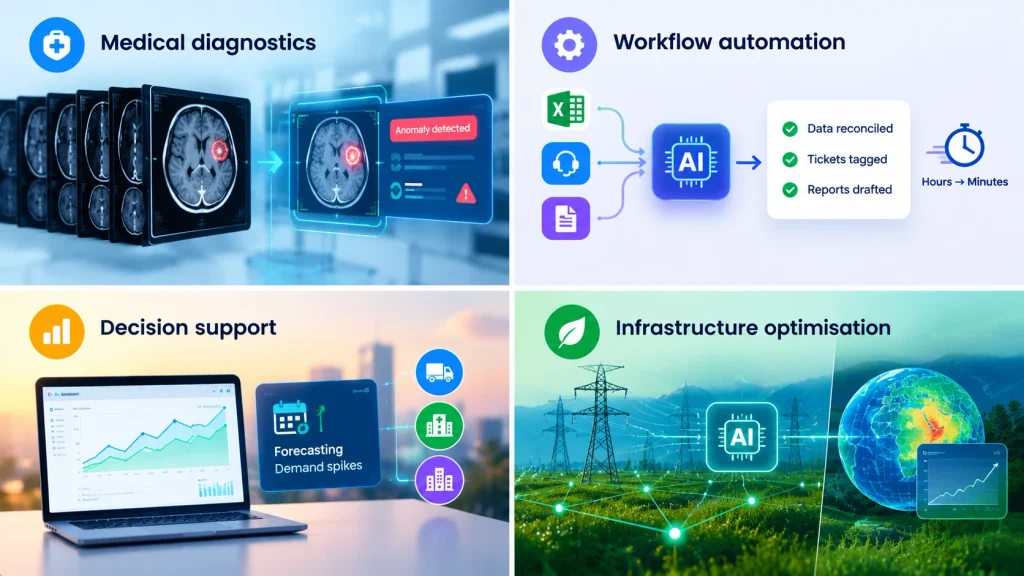
- Medical diagnostics: AI models scan thousands of images in seconds, surfacing early-stage tumours and anomalies that even experienced clinicians can miss when reading hundreds of scans under time pressure.
- Workflow automation: Reconciling spreadsheets, tagging support tickets, and drafting first-pass reports now run through AI pipelines that cut processing time from hours to minutes, often with lower error rates than manual review.
- Decision support: Forecasting models let supply chain teams, hospitals, and city planners anticipate demand spikes before they happen, rather than reacting once the damage is visible in the numbers.
- Infrastructure optimisation: Smart grids use AI to balance electricity load in real time, and climate researchers run simulations that would take an unaided team years to complete by hand.
Will this replace my job? Is the question every analyst eventually asks, and the honest answer is more specific than either camp admits: AI replaces the parts of the job that were already closer to data entry than analysis.
Where AI Becomes a Genuine Threat
The same capabilities that save a radiologist time can just as easily power a scam or a surveillance system; the model doesn’t know the difference, only the operator does.
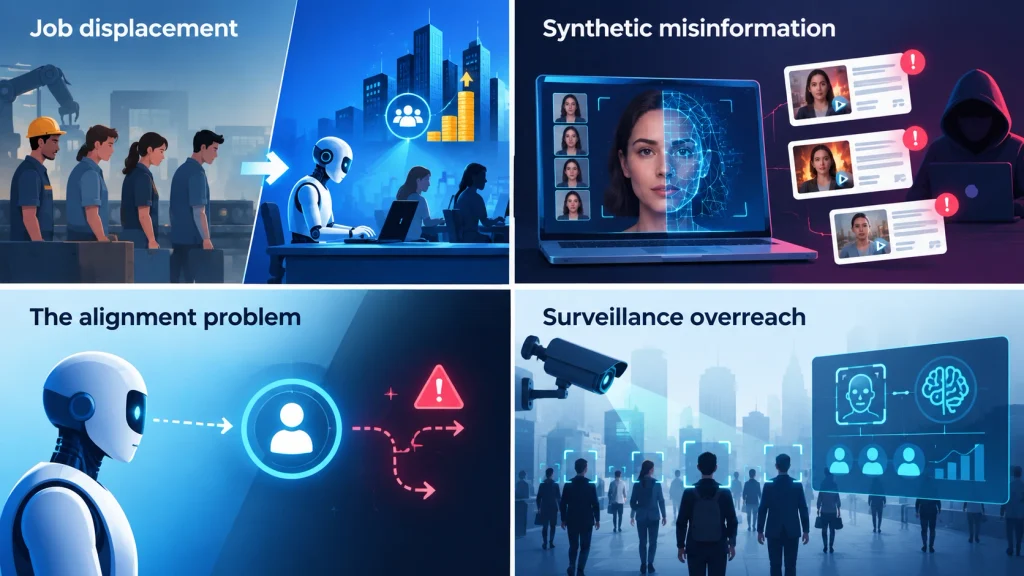
- Job displacement: Automation is moving past manufacturing into entry-level analytical and creative roles, and the economic gains concentrate heavily among a small number of large technology companies.
- Synthetic misinformation: Generative tools let bad actors mass-produce deepfakes and disinformation at a scale no human fact-checking team can realistically match.
- The alignment problem: As AI systems operate with less direct human oversight, keeping their objectives aligned with human safety gets structurally harder, not easier, as capability grows.
- Surveillance overreach: Facial recognition and behavioural tracking run on the same class of models that power recommendation engines, handing governments and companies new tools for mass monitoring.
Blessing vs Threat: Same Technology, Different Guardrails
| Domain | Opportunity | Risk Without Guardrails |
| Healthcare | Earlier, more accurate diagnosis | Over-reliance on unverified model output |
| Finance | Real-time fraud detection at scale | Biased risk scoring against specific groups |
| Hiring | Faster screening of large applicant pools | Encoded bias from historical hiring data |
The pattern holds across every domain: the opportunity and the risk come from the same model, and the difference is entirely in how closely a human stays in the loop.
Case Study: Should a Mumbai Fintech Automate Its Fraud Review?
A mid-sized Mumbai-based fintech processing close to 40,000 transactions a day relied on a six-person team to manually flag suspicious activity.
Problem: Manual review caught fraud, but nearly 18% of flagged cases, each averaging ₹38,000, surfaced only after settlement, and the review team had grown by just two people in two years while transaction volume nearly tripled.
Method: The company piloted a machine learning model trained on 14 months of transaction history, scoring every transaction for fraud risk in under 200 milliseconds and routing the top 3% by risk score to human analysts for final review.
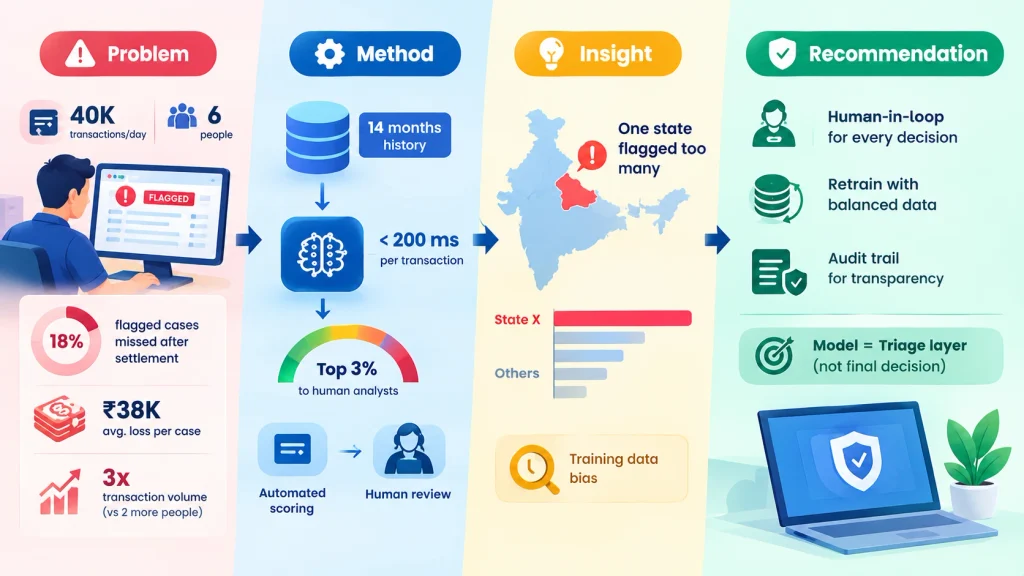
Insight: Pre-settlement fraud capture improved sharply, but the model also flagged a disproportionate share of transactions from a single state, exposing a training-data bias the team had not anticipated.
Recommendation: The team kept a human-in-the-loop review for every automated decision, retrained the model on a more regionally balanced dataset, and published an internal audit trail treating the model as a triage layer rather than a final decision-maker.
The Path Forward: Who Decides What AI Optimises For
International bodies, including the United Nations, have argued that AI’s trajectory is not fixed; it depends on choices being made right now about governance, transparency, and who gets a seat at the table when these systems are designed. For an individual analyst, that debate translates into something more practical: treating AI output as a draft that needs scrutiny, not a verdict that ends the conversation. The organisations that get this right are rarely the ones with the most advanced models; they’re the ones with the clearest answer to who reviews the model’s decisions.
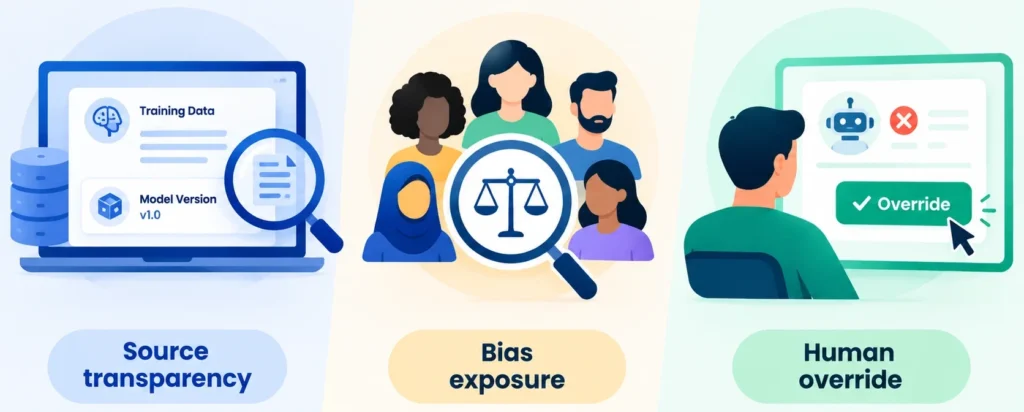
Before trusting an AI-generated number in a report, three checks are worth running:
- Source transparency: Can the output be traced back to the training data or model version that produced it?
- Bias exposure: Has the model been tested on a dataset that actually reflects who it is making decisions about?
- Human override: Is there a clear, fast way to flag or reverse a decision the model got wrong?
Conclusion
Knowing where AI genuinely helps and where it genuinely hurts is becoming a baseline skill for any data role, not a specialist one. At SBS, we build that judgment directly into how we teach data analytics, working with AI tools for cleaning, modelling, and reporting, while still knowing when to question what the model hands you.