Two frameworks are colliding within every company that touches machine learning, and most teams have not decided who owns which.
Key Takeaway: Data governance is not being replaced by AI governance; it is becoming the foundation AI governance stands on. Companies that treat them as separate, competing initiatives end up with clean data and unaccountable models, or well-documented models trained on data nobody can trust.
A mid-size retail company rolls out a demand-forecasting model. The data team has spent two years cleaning customer and inventory records. Six months in, the model starts recommending stock levels that ignore a regional festival spike, and no one can explain why. That gap clean inputs, opaque outputs is exactly where data governance ends and AI governance begins.
Data Governance vs AI Governance: What’s the Difference?
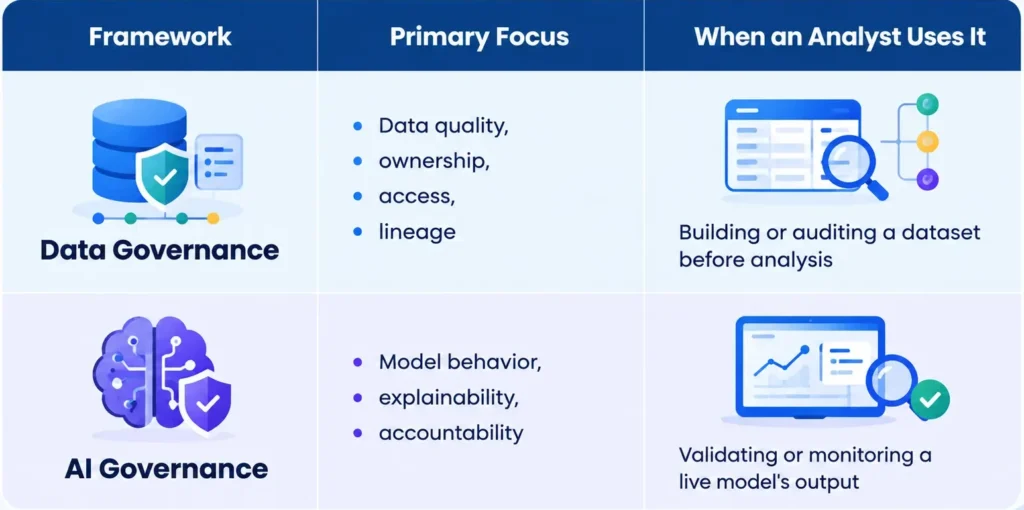
Data governance focuses on the raw material: who owns a dataset, how accurate and complete it is, who can access it, and how long it is retained. AI governance focuses on the decisions built on top of that data: how a model was trained, whether its predictions can be explained, and who is accountable when it gets something wrong.
Why This Distinction Actually Matters
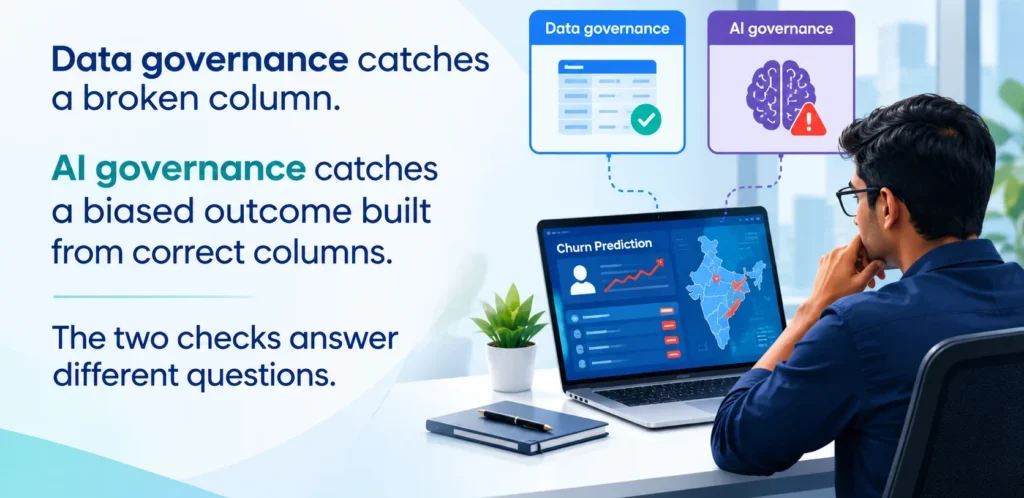
An analyst auditing a churn-prediction model at an Indian fintech found the underlying data was 98 percent accurate, yet the model was penalizing customers from certain PIN codes more heavily a pattern no data-quality check would ever catch. Common mistake: teams run a single audit and assume it covers both data and model risk. It does not. Data governance catches a broken column. AI governance catches a biased outcome built from correct columns. The two checks answer different questions, and skipping either one leaves a blind spot.
Conclusion
Understanding this split is now a baseline skill for any analyst working near machine learning systems, not just data scientists. In our Data Analytics with AI program, we cover both frameworks together, from auditing a dataset to evaluating the model sitting on top of it so you can walk into either conversation with confidence.